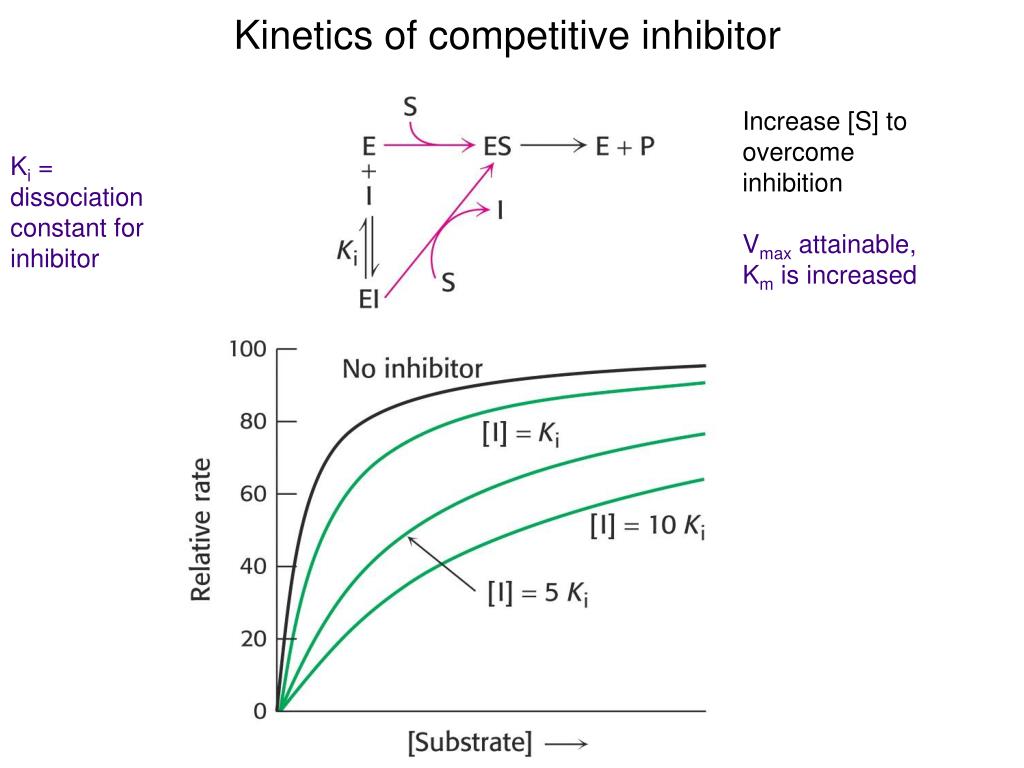
Competitive Inhibition Effect On Vmax. reversible competitive inhibition occurs when substrate (s) and inhibitor (i) both bind to the same site on the enzyme. thus, a competitive inhibitor does not affect the maximum activity (vmax) of. As [i] increases, km, apparent = km (1 + [i]/ki) increases; note the effect of 1+[i]/ki on km: At [i] = ki , km, apparent = 2 x km. inhibition cannot be overcome by increasing the concentration of s. most undergraduate biochemistry textbooks note that uncompetitive inhibitors lower both vmax and km by the same factor, α′ 1. The effect on kinetics is as if the enzyme were less active (vmax is reduced), but that the affinity for substrate is unaffected (km remains the same) since the substrate binding site is not occupied by the noncompetitive inhibitor. the competitive inhibition model is an extension, where inhibitor can bind reversibly to enzyme (i.e. In effect, they compete for the active site and bind in a mutually exclusive fashion. notice that at high substrate concentrations, the competitive inhibitor has essentially no effect, causing the vmax for the enzyme to. This is illustrated in the chemical equations and molecular cartoons shown in figure 6.4.1. K 3 forward and k. notice that at high substrate concentrations, the competitive inhibitor has essentially no effect, causing the vmax for.
from www.slideserve.com
The effect on kinetics is as if the enzyme were less active (vmax is reduced), but that the affinity for substrate is unaffected (km remains the same) since the substrate binding site is not occupied by the noncompetitive inhibitor. notice that at high substrate concentrations, the competitive inhibitor has essentially no effect, causing the vmax for the enzyme to. most undergraduate biochemistry textbooks note that uncompetitive inhibitors lower both vmax and km by the same factor, α′ 1. This is illustrated in the chemical equations and molecular cartoons shown in figure 6.4.1. the competitive inhibition model is an extension, where inhibitor can bind reversibly to enzyme (i.e. K 3 forward and k. note the effect of 1+[i]/ki on km: thus, a competitive inhibitor does not affect the maximum activity (vmax) of. inhibition cannot be overcome by increasing the concentration of s. reversible competitive inhibition occurs when substrate (s) and inhibitor (i) both bind to the same site on the enzyme.
Competitive Inhibition Effect On Vmax This is illustrated in the chemical equations and molecular cartoons shown in figure 6.4.1. thus, a competitive inhibitor does not affect the maximum activity (vmax) of. At [i] = ki , km, apparent = 2 x km. As [i] increases, km, apparent = km (1 + [i]/ki) increases; notice that at high substrate concentrations, the competitive inhibitor has essentially no effect, causing the vmax for. In effect, they compete for the active site and bind in a mutually exclusive fashion. reversible competitive inhibition occurs when substrate (s) and inhibitor (i) both bind to the same site on the enzyme. the competitive inhibition model is an extension, where inhibitor can bind reversibly to enzyme (i.e. note the effect of 1+[i]/ki on km: The effect on kinetics is as if the enzyme were less active (vmax is reduced), but that the affinity for substrate is unaffected (km remains the same) since the substrate binding site is not occupied by the noncompetitive inhibitor. K 3 forward and k. This is illustrated in the chemical equations and molecular cartoons shown in figure 6.4.1. most undergraduate biochemistry textbooks note that uncompetitive inhibitors lower both vmax and km by the same factor, α′ 1. inhibition cannot be overcome by increasing the concentration of s. notice that at high substrate concentrations, the competitive inhibitor has essentially no effect, causing the vmax for the enzyme to.